Daily Routing Brief — 2026-06-08
Generated 2026-06-08T18:29:43.155616+00:00 · Newport→Bermuda 2026 · T−11 days · « all briefs
Regime: PRACTICE + OCEAN-TRACKING — T−11 days. No atmospheric model reaches race day yet (~7-day horizon). The codes below are crew practice, not a June-19 forecast. The genuinely predictive signal this far out is the Gulf Stream — track its evolution below.
PRE-RACE PRACTICE ONLY — not for use during the race
These are pre-race research / practice reps. Per RRS 41 (2026 NOR) a boat shall not receive routing assistance from shore — including AI-generated — while racing. This page stops updating before the June 19 start; do not open it from the boat once racing.
Headline
Current forecast window most resembles 2024 (W-PF/W-RC/W-BH, score 5.10).
- Winner that year: Carina (Rives Potts) — 64h 12m corrected
- What won: Avoid frontal light patch at start; ride the meander then exit at the right latitude
- Winning tactics: T-PF T-ME T-CL
- Lesson: Start positioning south of frontal light patch was race-defining. Clean meander exit beat staying in too long.
- Best corridor that year: RHUMB
Per-period classification (current window)
Start anchor: 2026-06-08T00:00:00+00:00 · horizon +167 h
| period | code | conf | GFS | ECMWF | ICON |
|---|---|---|---|---|---|
| P1 start / coastal | W-PF /W-SQ (3/3) | HIGH (100%) | 14.5/28.8 | 18.1/29.5 | 17.5/32.9 |
| P2 Gulf Stream crossing | W-LA | MEDIUM (67%) | 8.6/13.2 | 7.1/17.3 | 7.7/16.5 |
| P3 Bermuda approach | W-BH | MEDIUM (67%) | 8.3/12.2 | 7.7/15.9 | 8.5/16.1 |
Codes are atmospheric only and link to the analog framework. The GFS/ECMWF/ICON columns are mean wind / max gust (kn). Confidence = model agreement. See the method.
AI medium-range cross-check (ECMWF-AIFS)
A separate read from the data-driven ECMWF-AIFS model — strongest in the 4–10 day range on the large-scale pattern, with less run-to-run swing. A third opinion vs the core GFS/ECMWF/ICON vote above, not blended into its confidence and not for short-term or routing detail. (GraphCast is offline on Open-Meteo right now, so this is AIFS-only; AIFS carries no gust field.)
| period | AIFS read | vs core |
|---|---|---|
| start / coastal | W-PF | matches core |
| Gulf Stream crossing | W-BH | core says W-LA |
| Bermuda approach | W-PF | core says W-BH |
When AIFS agrees with the core models on the medium-range pattern, lean into that regime; when it diverges, treat the period as genuinely uncertain and don't over-commit. Source: Open-Meteo (ECMWF-AIFS, ecmwf_aifs025_single).
Trend (day over day)
vs 2026-06-07 (T−12):
- Headline analog changed: 2012 → 2024.
- Period codes: P1 W-BH→W-PF; P2 W-BH→W-LA.
- Model agreement: 89% ↓ 78%.
- New Gulf Stream snapshot: 2026-06-07 → 2026-06-08.
- Crossing SST: 25.2→24.3 °C (77→76 °F) ↓, north-wall jump +1.5°C (+3°F).
- Peak corridor wave: 1.7→2.0 m (6→7 ft) ↑.
Convergence: race day not yet in model horizon — convergence tracking begins automatically once it is (~T−7).
Analog ranking (period-aware)
| rank | year | score | P1/P2/P3 | best corridor |
|---|---|---|---|---|
| 1 | 2024 | 5.10 | W-PF/W-RC/W-BH | RHUMB |
| 2 | 2012 | 5.10 | W-PF/W-BH/W-BH | RHUMB |
| 3 | 2022 | 4.65 | W-PF/W-CC/W-BH | EAST |
| 4 | 2016 | 2.55 | W-PF/W-CC/W-PL | RHUMB |
2014 excluded as seed data. Years link to their winner-route writeups.
Gulf Stream (observed — the real signal this far out)
Latest local snapshot: 2026-06-08 (0 days old)
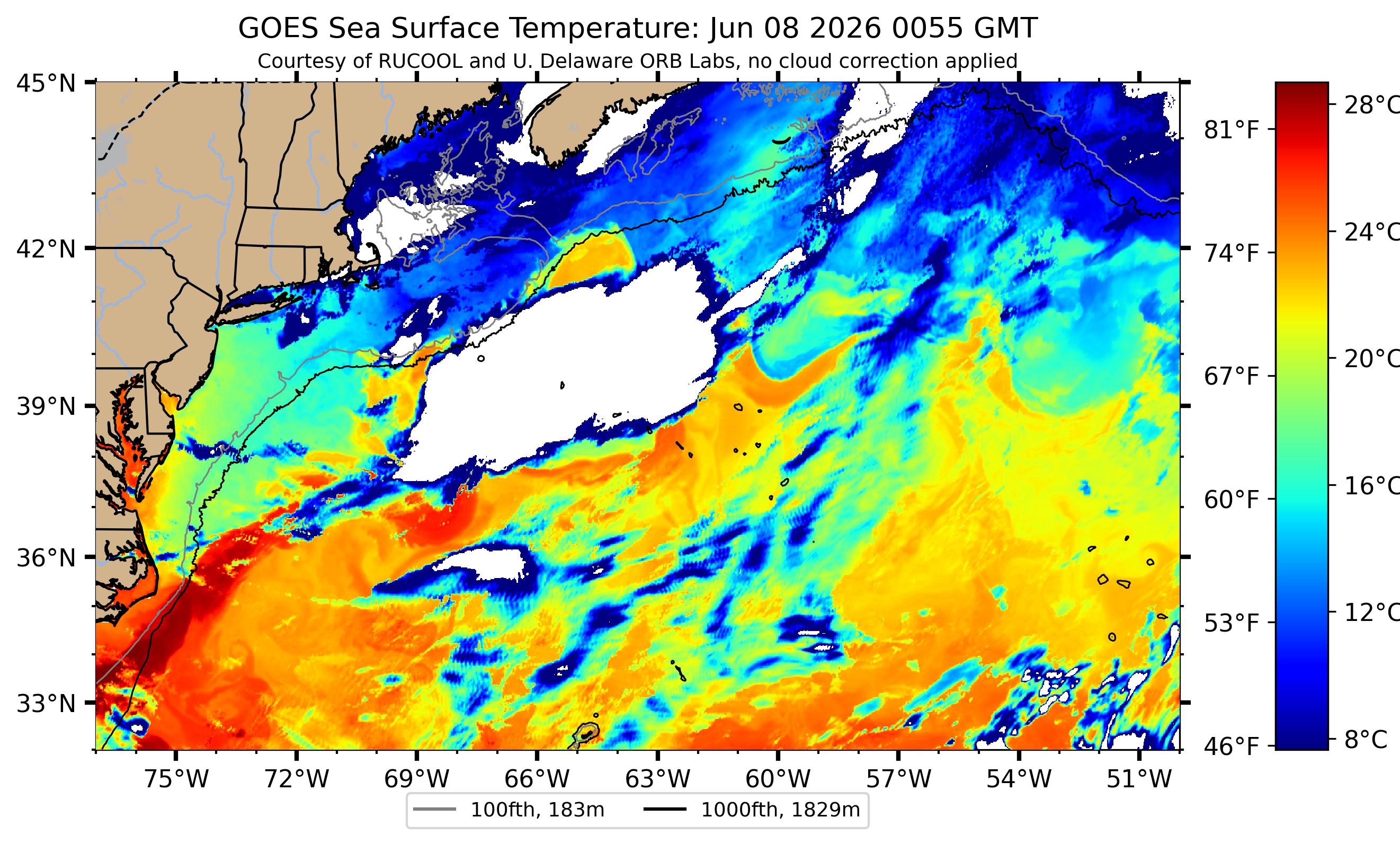 Clearest satellite SST pass for 2026-06-08 (Rutgers RUCOOL). Full imagery set + Frank Bohlen's note:
 data/gulfstream-monitor/2026-06-08/.
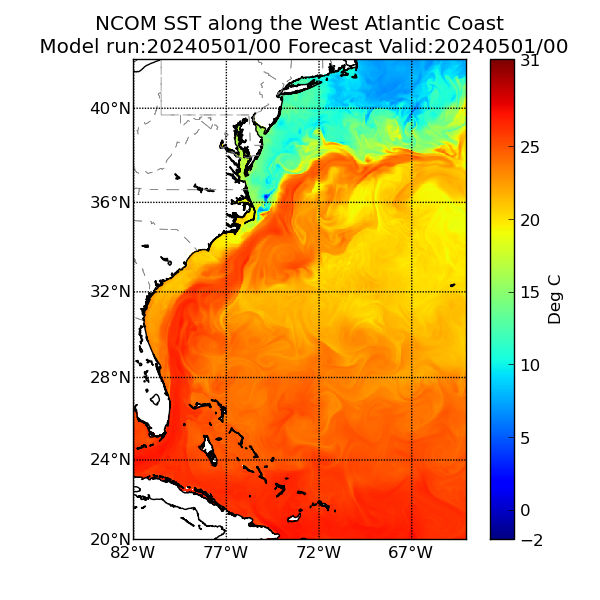
A cold-core ring or meander near the rhumb persists for weeks, so today's Stream state genuinely informs June 19 — see the corridor decision page. Stream codes (W-RC/W-CC/W-WE/W-AC) come from this observed data, not the atmospheric forecast.
Crossing corridor with the 2026-05-30 Stream walls + eddy (9 days old), frozen for this brief.
Full interactive planning map — all six past corrected-time winners' tracks over the corridor (toggle layers).
Data sources
- Forecast (wind · gust · pressure — GFS·ECMWF·ICON): Open-Meteo · full list in the Sources & Tools catalog.
- Gulf Stream SST: NOAA OPC NCOM · Rutgers RUCOOL · NASA SPoRT.
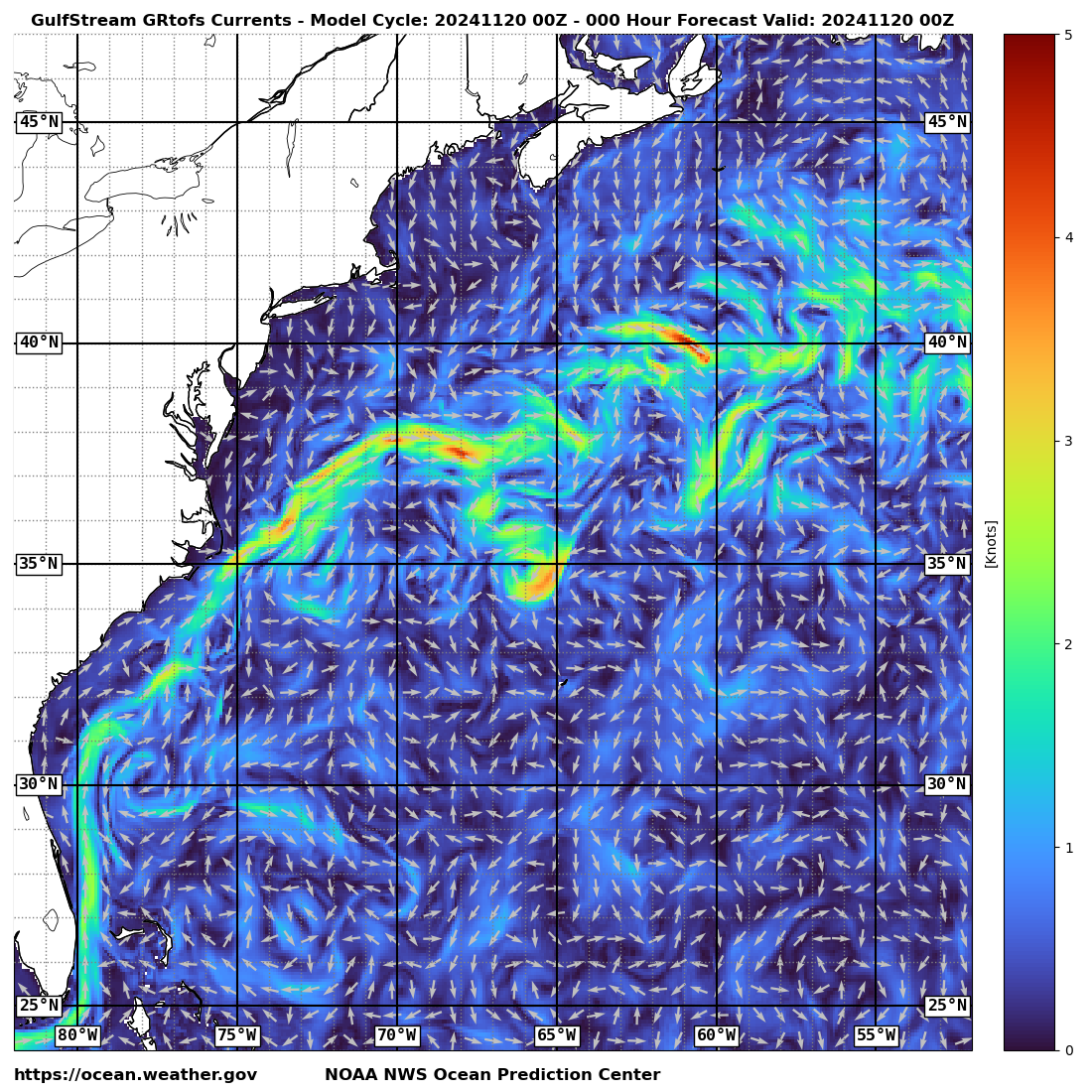
- Gulf Stream currents: NOAA OPC RTOFS · AOML altimetry.
- Expert read: Frank Bohlen's Gulf Stream notes.
Sea state & ocean (numeric — Open-Meteo Marine)
Near-term (next 24 h) means along the corridor. SST and waves are reliable; ocean current is a COARSE model that understates the Gulf Stream (2–4 kn) and cannot see rings or meanders — trust the Stream imagery for structure.
| waypoint | SST | current | wave |
|---|---|---|---|
| start | 14.6 °C / 58 °F | 0.4 kn @ 221° | 1.3 m (4 ft) / 6 s |
| shelf | 22.8 °C / 73 °F | 0.5 kn @ 235° | 1.7 m (6 ft) / 6 s |
| stream | 24.3 °C / 76 °F | 2.7 kn @ 345° | 2.0 m (7 ft) / 6 s |
| post_stream | 22.5 °C / 72 °F | 0.4 kn @ 268° | 1.4 m (5 ft) / 6 s |
| approach | 23.8 °C / 75 °F | 0.5 kn @ 78° | 0.8 m (3 ft) / 6 s |
North wall: shelf→crossing SST change is only +1.5 °C / +3 °F — front is weak/diffuse or displaced from the rhumb waypoint in this coarse model.
Sea state: peak corridor wave ~2.0 m (7 ft).
Wind-against-current — expect steep, short seas: stream (18.3 kn wind vs 2.7 kn current, 38° apart). Opposed flow stacks the wave train; ease into it and protect the crew/boat. (Coarse model current — confirm against Stream imagery; the real Gulf Stream is stronger, so true wind-against-Stream seas can be worse than this flags.)
Race-day horizon
Race day is T−11 — beyond the ~7-day model horizon. The classifier correctly declines (no fabricated race-day codes). Convergence tracking begins automatically when race day enters the window (~T−7).
Sources: forecast — Open-Meteo (GFS/ECMWF/ICON, no key). Analogs — framework + winner routes + tactics. Gulf Stream — scripts/gulfstream_monitor. Method — forecast analog matcher. Pipeline — scripts/daily_brief.py.